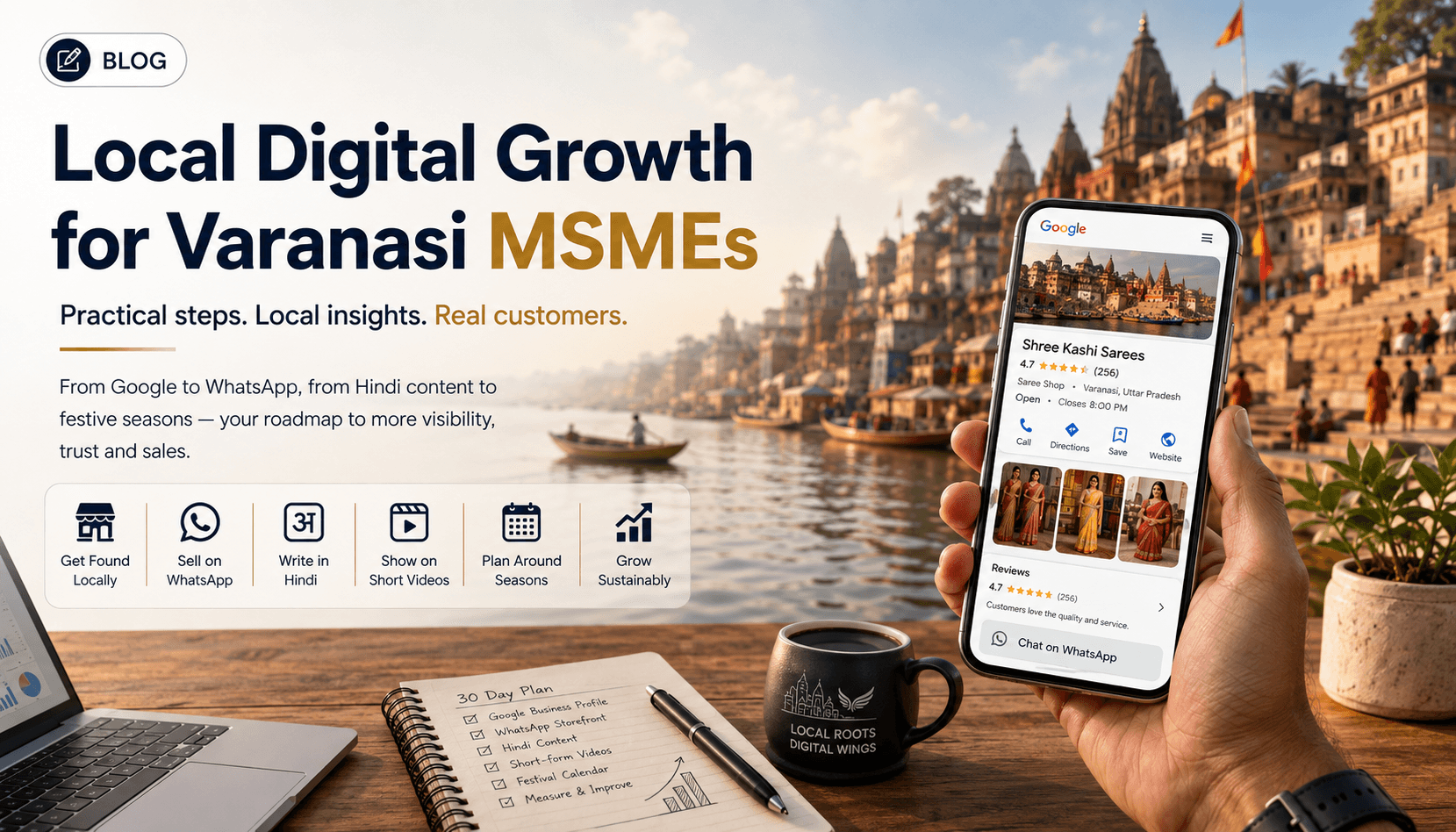

Your next customer in Varanasi is holding a phone. They searched for what you sell, read the results in Hindi, checked whether anyone had reviewed you, and bought from the shop that answered fastest — probably paying by UPI. None of that required a website, a big budget, or an agency. It required being findable at the moment they looked.
This guide covers the channels that move customers in Varanasi, in the order worth doing them, with the evidence behind each one. Where a claim rests on a study, the study is named, with a link to the source or to coverage of it. Where it rests on judgement rather than data, it says so.
Key Takeaways
- Free channels come first. Google states that local rankings are decided by relevance, distance and prominence — two of which you control directly through a complete Business Profile.
- Write in Hindi. 57% of India's urban internet users prefer content in regional languages, and rural users skew further that way.
- Digital adoption pays broadly, but the evidence is national and general, not specific to any one channel. Among 3,249 Indian MSMEs surveyed by Google and the India SME Forum, 78% reported lower customer acquisition costs.
- Varanasi's calendar is a real asset. Sawan, Dev Deepawali and the wedding muhurat windows create predictable demand spikes a national playbook will not tell you about.
1. Start with your Google Business Profile
If you do one thing this month, claim and complete your Google Business Profile. It is free, it takes an afternoon, and it decides whether you appear when someone nearby searches for what you sell.
You do not have to guess at what matters here, because Google publishes it. Local results are ranked on three factors: relevance (how well your profile matches the search), distance (how far you are from the searcher), and prominence (how well known the business is, based on things like links and customer reviews), per Google Business Profile Help, retrieved 5 August 2026.
Distance you cannot change. Relevance and prominence you can. Relevance means your exact category, real opening hours including festival closures, your service area, and product or service listings written in the words customers actually use. Prominence is built mainly through reviews and through other sites referring to you.
Photographs are worth more effort than most owners give them. A saree shop with twenty clear images of actual inventory gives a customer a reason to walk in. A profile with one blurry shopfront photo gives them a reason to keep scrolling. Businesses in Godowlia, Lanka, Sigra and Bhelupur compete for the same map positions, and a complete profile beats a half-finished one on the relevance factor alone.
One newer reason to finish the profile properly: the same information now feeds Google's AI answers, not just the map pack. We cover what that changes — and what it does not — in our guide to AI search visibility.
Reviews are the part most owners avoid and the part that compounds, because they feed prominence directly. Ask every satisfied customer in person, at the moment they are happy. Reply to all of them, including the critical ones — a calm, specific reply to a complaint reads better to the next customer than a wall of five-star ratings with no owner presence at all.
One hard rule: never offer payment, discounts or free goods in exchange for a review. Google's Maps user-generated content policy (retrieved 5 August 2026) prohibits incentivised reviews outright, and enforcement falls on the profile you are trying to build.
2. Use WhatsApp as a storefront, not an inbox
Many Varanasi businesses already run on WhatsApp, but comparatively few run it deliberately. That gap is where the opportunity sits. Treating WhatsApp as an inbox means answering messages as they arrive. Treating it as a storefront means the WhatsApp Business app with your catalogue loaded, product photos and prices attached, a greeting message that fires after hours, quick replies saved for the five questions you answer every day, and labels separating a new enquiry from a repeat buyer from a wholesale account.
The catalogue earns the most from the least effort. When a customer asks kya rate hai, a catalogue link answers faster than a typed reply and shows them nine other things they did not ask about. A typed number invites a single-item decision; a catalogue invites browsing. That is a reasoned expectation about buying behaviour rather than a measured finding — test it against your own enquiries.
One discipline separates useful broadcast lists from muted ones: send only when you have something specific. A new consignment, a festival timing change, a genuine discount. Daily "good morning" images train customers to ignore you, and the mute is permanent.
Payment closes the loop, and the habit is already established nationally. UPI processed 21.63 billion transactions in December 2025 — then its highest month on record — and roughly 228 billion transactions worth about ₹300 lakh crore across calendar year 2025, against 172 billion in 2024 (NPCI UPI product statistics, as reported by Deccan Chronicle, January 2026, retrieved 5 August 2026). Volumes have almost certainly risen further since. Your customer does not need convincing to pay by phone; they need you to show a QR code without being asked.
Source: NPCI UPI product statistics, as reported by Deccan Chronicle, January 2026.
3. Write in Hindi, not just English
This is the cheapest advantage available to a Varanasi business.
The Internet in India Report 2024, published on 17 January 2025 by the Internet and Mobile Association of India with Kantar, counted 886 million active internet users in India, growing 8% year on year. Rural India accounted for 488 million of them — 55% of the country's internet population — and was growing at roughly twice the urban rate. The finding that matters most here: 57% of urban internet users prefer content in regional languages (IAMAI; summary via IBEF, retrieved 5 August 2026). The underlying ICUBE 2024 study surveyed more than 90,000 households across every state and union territory except Lakshadweep, which makes it one of the better-grounded numbers in this guide.
That is urban users, not rural. The assumption that city customers want English does not hold, and Varanasi's trade catchment reaches well into surrounding rural districts where the preference runs stronger.
Source: Internet in India Report 2024, IAMAI & Kantar, 17 January 2025. Urban figure derived as 886M − 488M.
In practice: your Business Profile description in Hindi as well as English, product names customers actually use rather than catalogue English, Hindi captions on social posts, and staff replying on WhatsApp in whichever language the customer opened with. Bhojpuri in spoken video carries real warmth in this region and costs you nothing anywhere else.
Avoid machine-translating English marketing copy into Hindi. It reads as foreign and customers notice. Write the Hindi as Hindi.
4. Show the craft on short-form video
Varanasi sells things that are more persuasive in motion than in a photograph. A handloom in operation, a thali being assembled, a wooden toy being lathed and painted, silk catching light as it unfolds. Static images undersell all of it.
An honest caveat before the advice: we could not find a credible, methodologically transparent study measuring short-form video performance for Indian small businesses specifically. Published figures on Reels reach, engagement and advertising costs in India trace back overwhelmingly to marketing blogs citing other marketing blogs. So the case for video here rests on the nature of the product, not on a statistic — and you should judge it from your own account, not from anyone's headline number.
What is measurable is audience scale. DataReportal's Digital 2025: India, published 25 February 2025, counted 491 million social media user identities in India at the start of 2025 — 33.7% of the population, up 29 million year on year (DataReportal, retrieved 5 August 2026). Identities are not unique people, since one person may hold several accounts, so read that as an upper bound on reach rather than a headcount.
You do not need production equipment. A phone, daylight and a steady hand cover it. What you need is a subject worth watching for fifteen seconds: the loom, the hands, the finished piece. Point the camera at the work, not at yourself talking about the work.
Post regularly rather than perfectly. Three ordinary clips a week give you more chances to be seen than one polished film a month, simply because there are more posts in circulation. Treat that as arithmetic, not as a claim about how any platform ranks content.
5. Build your calendar around Varanasi's seasons
This is the section no national marketing guide can write for you, and it is the largest structural advantage of operating here.
Varanasi's demand does not follow a flat commercial year. It follows a religious and social calendar with sharp, predictable peaks. Sawan brings a heavy pilgrim influx toward Kashi Vishwanath through the monsoon month. Mahashivratri concentrates enormous footfall into a single day. Dev Deepawali, falling on Kartik Purnima roughly a fortnight after Diwali, lights the ghats and fills the city, with Ganga Mahotsav running in the days before it.
The wedding season deserves more precision than it usually gets, because the gaps matter as much as the peaks. Weddings are solemnised on auspicious muhurat dates, and two long windows remove them from the calendar entirely: Kharmas, when the Sun transits Sagittarius (roughly mid-December to mid-January) and again Pisces (roughly mid-March to mid-April), and Chaturmas, from Devshayani to Devuthani Ekadashi across the monsoon months. A shop planning bridal inventory around a vague "November to February" season will stock for a mid-December fortnight in which almost nothing is booked. Subtracting those windows leaves roughly mid-January to mid-March, mid-April to early July, and mid-November to mid-December as the booking-heavy stretches. All of these shift year to year with the lunar calendar, so check the actual muhurat list for the year before you commit stock or advertising spend.
For weavers and silk retailers there is a specific, underused asset. Banaras Brocades and Sarees — that is the registered name, not "Banarasi" — holds Geographical Indication registration No. 99, granted on 4 September 2009 across classes 23, 24, 25 and 26, applied for by the Banaras Bunkar Samiti with eight other organisations (Geographical Indications Registry, Intellectual Property India, retrieved 5 August 2026). The registration has been in force since 2009, with the current term running to 3 July 2027 and renewable after that — worth diarising if your marketing leans on it.
One important qualification, because getting this wrong carries legal risk. GI rights do not belong to anyone who happens to weave in Varanasi. They vest in the registered proprietor and in registered authorised users. If you are a registered authorised user, say so explicitly and explain what the GI guarantees a buyer — it separates you from every reseller listing "Banarasi-style" fabric online. If you are not registered, do not imply that you are. Check your standing, or apply, before you build marketing around the claim.
Working with this calendar means preparing four to six weeks ahead of each peak, not during it. By the time Dev Deepawali arrives, visitors have already booked, chosen and searched. Update your Business Profile hours before the festival week, not after a customer reaches a closed shutter.
6. Spend on ads only after the free channels work
Advertising amplifies what already converts. It does not fix what does not. Running ads to a business with no reviews, no photographs and no catalogue means paying to send strangers to a dead end.
The most-cited evidence here needs careful reading. The Google Dividend: Measuring Digital Commerce's Contribution to India's Economic Future, published 8 July 2026 from a survey of 3,249 Indian MSMEs, reported that 78% experienced a reduction in customer acquisition costs, 66% improved market access, around 60% recorded double-digit revenue growth, 58% acquired more customers, and 54% earned at least two to three times their digital advertising investment, some reporting up to five times (India SME Forum; see also coverage by Storyboard18 and Exchange4media, retrieved 5 August 2026).
Three caveats, all of which cut the same way. The study was published by Google and the India SME Forum — Google has a commercial interest in the finding that advertising on its platforms pays. The figures are self-reported by surviving businesses, which excludes those that tried digital marketing and quit. And except for the ROAS number, these measure digital adoption generally, not paid advertising specifically. Treat the whole set as an optimistic upper range, not a forecast for your shop.
Source: The Google Dividend, Google & India SME Forum, 8 July 2026 (n=3,249, primary survey plus macroeconomic modelling). Self-reported; publisher has a commercial interest in the result. All figures except ROAS measure digital adoption broadly, not paid advertising alone.
Start small and local. A modest daily budget on search ads, bounded tightly to Varanasi and its immediate districts, against the specific terms customers use to buy rather than to browse. Measure enquiries, not impressions. Set a defined budget and a defined period, then judge it honestly against what walked through the door.
One arithmetic warning: a return of two to three times revenue on ad spend is not two to three times profit. Subtract your cost of goods before you celebrate. If you want the full working — how to derive a maximum cost per enquiry from your own margins instead of borrowing a benchmark — see our guide to what digital marketing actually costs in India.
7. What each channel costs you
A rough comparison to help you sequence the work.
| Channel | Money cost | Your time | Time to result |
|---|---|---|---|
| Google Business Profile | None | One afternoon, then monthly upkeep | 2–6 weeks |
| WhatsApp Business | None | A day to set up the catalogue | Immediate |
| Hindi content | None, if written in-house | Ongoing, small | 4–8 weeks |
| Short-form video | None beyond a phone | 2–3 hours weekly | 2–4 months |
| Seasonal planning | None | A half-day, twice a year | Next festival cycle |
| Paid search ads | Daily budget, ongoing | Weekly review | Days — but only after the above |
8. Your first 30 days
A workable order of operations, assuming you are starting from nothing — one step per week.
- Claim your Google Business Profile. Fill every field. Upload at least fifteen photographs of real inventory and the actual premises. Set correct hours, including weekly closures and upcoming festival days.
- Install WhatsApp Business. Build the catalogue with photographs and prices. Write your greeting message and five quick replies. Print a UPI QR code and put it where customers see it without asking.
- Ask your next thirty satisfied customers for a Google review, in person, at the counter — with no incentive attached. Reply to every review that arrives. Add Hindi to your profile description and product names.
- Record six short videos of the work itself and post three. Map your next two demand peaks against this year's actual muhurat and festival dates, and mark the date six weeks before each one — that is when preparation starts.
Only after all of that is running should you consider paid advertising. The sequence matters more than the speed.
Working through this list and want a second opinion on the order?
Vision Wings Marketing works with growth-stage businesses from Varanasi. If you want your channel priorities reviewed against what your category and season actually demand, we will look at it with you.
Talk to usFrequently asked questions
How much should a small Varanasi business spend on marketing per month?
Start at zero. A Google Business Profile, WhatsApp Business, review collection and phone-shot video cost nothing but time, and they need to work before spending makes sense. When you do start advertising, begin with an amount you could lose entirely without harm, run it for a defined period against a specific goal, and expand only on measured results. No benchmark percentage transfers usefully across businesses as different as a saree wholesaler and a coaching centre.
Do I need a website, or is a Google Business Profile enough?
For a shop selling locally to walk-in customers, a complete Business Profile plus a WhatsApp catalogue covers most of what a basic website would do, and does it where customers are already looking. A website earns its cost when you sell beyond Varanasi, need to publish detailed information, or want to control a booking or enquiry process end to end. Note that Google counts links to your business as part of prominence, so a website can support rankings indirectly — but get the profile right first either way.
Should I market in Hindi or English?
Both, with Hindi as the default rather than the afterthought. The IAMAI–Kantar Internet in India Report 2024 found 57% of urban internet users prefer regional-language content, and rural users — 55% of India's internet population — skew further that way. Keep English available for visitors and out-of-state buyers, but write the Hindi natively rather than translating English copy word for word.
How do I get customers to leave Google reviews?
Ask in person, at the counter, immediately after a good experience, and make it one tap by keeping a review QR code at the till. Do not offer discounts, payment, free goods or services in exchange — Google's Maps user-generated content policy prohibits incentivised reviews, and the risk falls on your profile. Reply to every review you receive, especially the negative ones, because the reply is read by the next customer deciding whether to trust you.
Can I use the Banaras Brocades and Sarees GI in my marketing?
Only if you are a registered authorised user of the Banaras Brocades and Sarees GI — that is the registered name, not "Banarasi" — held under registration No. 99 with the Geographical Indications Registry, Intellectual Property India. The rights vest in the registered proprietor and authorised users, not in every business operating in Varanasi. If you qualify, say so plainly and explain what it guarantees the buyer. If you do not, check your eligibility with the Registry before making any claim.
Where to start
The businesses that grow in Varanasi over the next few years will not be the ones with the largest budgets. They will be the ones that were findable when someone searched, answered in the language the customer thought in, and showed up before the season rather than during it.
Nothing in the first four weeks costs money. The profile, the catalogue, the reviews, the Hindi, the video of your own hands at work — all of it is available to any shop in Godowlia or Sigra or Lanka this week. Advertising comes after, and works better for having waited.
Claim the Google Business Profile this week. Everything else in this guide compounds on top of it.


