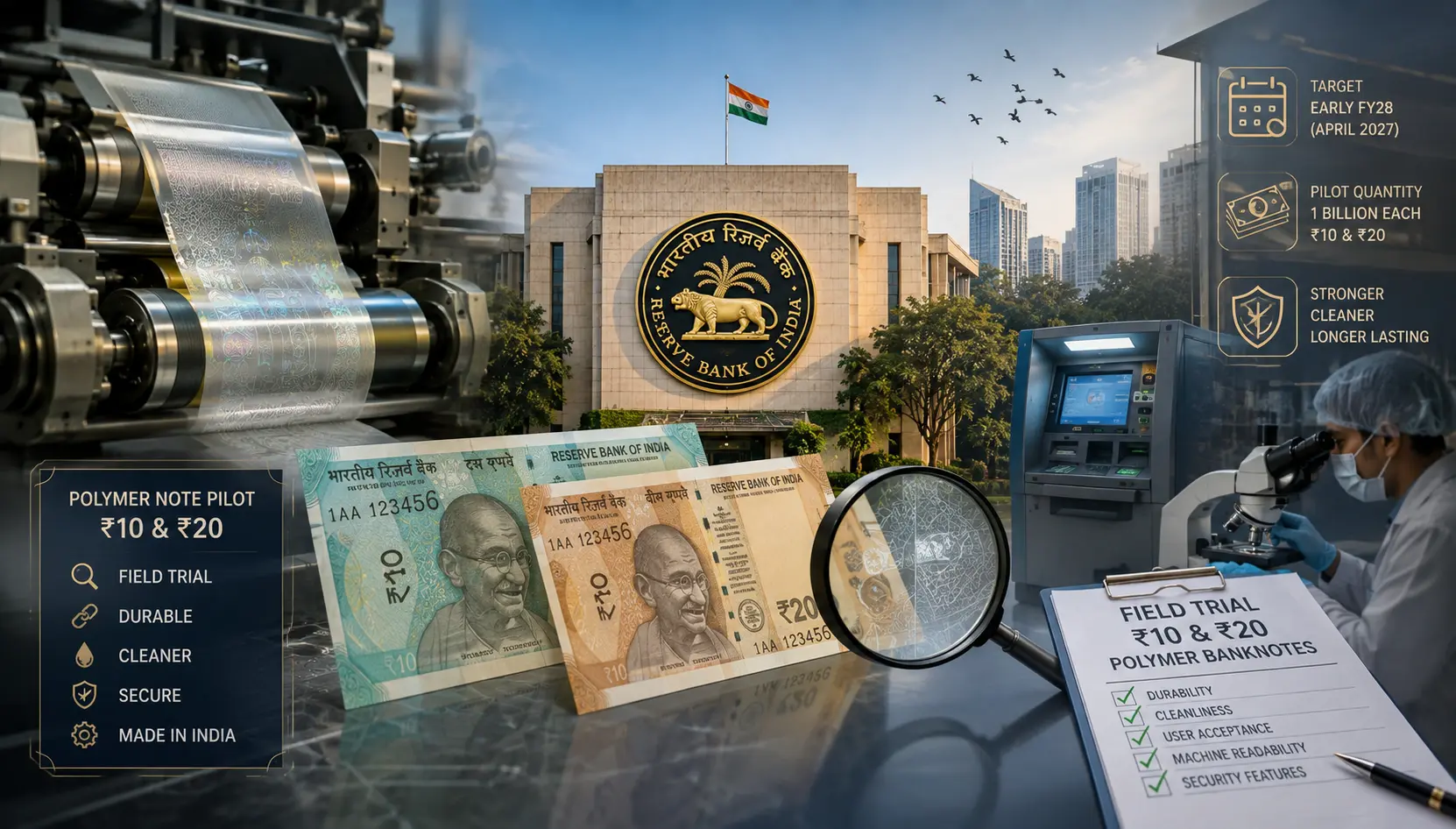

Buried in the tender India issued on 17 July 2026 for plastic banknote material is a sentence no other country has ever written. Suppliers must send ten sample sheets to a laboratory, and those sheets must be certified free of animal tallow and DNA content.
Roughly sixty countries print money on polymer. Not one of them imposes that condition. India does, because the last time it tried this — in 2018, for the ₹50 note — the plan died over exactly this issue. That one clause tells you more about why India has failed at plastic currency twice than any press release will.
This is the third attempt in fourteen years. It is better designed than the first two. It is also aimed at the two denominations that carry 1.4% of the value of India's cash, resting on a savings argument that is far weaker in India than the international headlines suggest. Here is what was actually approved, what the evidence says, and what it means for you.
Where a claim rests on a document, the document is named. Where published numbers disagree, that is said plainly instead of averaged away.
Key Takeaways
- It is a field trial, not a switchover. Two billion notes — one billion each of ₹10 and ₹20 — against the 30.3 billion banknotes India printed in 2024-25 alone. Parliament was told there is no proposal to replace paper.
- There is a target date. RBI Governor Sanjay Malhotra said on 5 August 2026 the aim is circulation "in the beginning of the next financial year" — FY28, from April 2027 — if trials succeed.
- The counterfeiting argument does not apply. India detected just 373 fake ₹20 notes in all of 2025-26. The RBI's own FAQ says the objective of polymer is to increase note life "and not to combat counterfeiting."
- India's savings case is weaker than Australia's or Britain's. Those countries replaced paper notes that died in 6 to 24 months. Peer-reviewed research puts the median life of an Indian ₹10 or ₹20 note at 4 to 5 years already.
- This is attempt number three. 2012 (₹10, five cities) collapsed on machine handling and a supplier bribery scandal. 2018 (₹50) collapsed over animal tallow. Both failures are now written into the tender.
- Watch 18 August 2026. That is when the substrate tender closes. A thin response would tell you more than any announcement.
1. What was actually decided, and by whom
Three decisions, three bodies, three weeks. Coverage has merged them into a single announcement nobody made, so keep them separate.
17 July 2026 — the manufacturing question. Bharatiya Reserve Bank Note Mudran Private Limited (BRBNMPL), the RBI's wholly owned note-printing subsidiary, issued a global Expression of Interest numbered EOI/04/CO/2026-27, seeking manufacturers of opacified polymer substrate for Indian banknotes. Applications close 18 August 2026. This is explicitly not a purchase order — BRBNMPL is looking for technology partners to build substrate manufacturing in India rather than import finished material (Business Today, 17 July 2026, retrieved 6 August 2026).
27 July 2026 — the political authorisation. Minister of State for Finance Pankaj Chaudhary told the Lok Sabha, in a written reply to an unstarred question, that the government had approved the RBI's proposal. The legal route matters: the RBI, on the recommendation of its Central Board, sent the proposal under Section 25 of the Reserve Bank of India Act, 1934, which requires the Centre to approve banknote design. Chaudhary's reply stated the proposal covers "1 billion pieces each of ₹10 and ₹20 polymer banknotes for field trials and for the regular issuance of polymer banknotes in these two denominations after the successful completion of field trials."
The same reply made three clarifications that most coverage skipped:
- There is no proposal to replace paper currency. Polymer notes circulate alongside it.
- Regular issuance happens only if the trials succeed.
- On whether this affects digital payments, the government said it is too early to say, and that the RBI regards banknotes and digital payments as "complementary modes of payment".
5 August 2026 — the timeline. At the press conference following the monetary policy review, Governor Sanjay Malhotra said the RBI is "targeting that they are in circulation, if everything goes as per plan, in the beginning of the next financial year." He noted polymer notes "have lasted for over 30 years in some jurisdictions" and would "come in handy, especially for the lower denomination notes which have high velocity" (Millennium Post, 5 August 2026, retrieved 6 August 2026).
Read the conditional. "If everything goes as per plan" is carrying weight, because twice before, it did not.
2. This is India's third attempt, not its first
Almost every article treats 2026 as a new idea. It is the third run at the same decision, and each failure was different.
2012 — the ₹10 note, five cities. On 13 December 2012 the Finance Ministry announced a field trial of one billion ₹10 polymer notes across five cities chosen for climatic spread: Kochi, Mysore, Jaipur, Shimla and Bhubaneswar. Humid coast, dry desert heat, cold hills. It was a well-designed test. The RBI's 2014-15 Annual Report recorded that a request for proposal had been issued and technically evaluated, but "owing to certain technical infirmities, the process of acquiring one billion pieces of bank notes could not be taken further."
2018 — the ₹50 note, and the tallow problem. A second attempt targeting ₹50 was dropped over concerns that animal tallow used in making polymer substrate could offend religious sentiment — sharpened in India by the common habit of wetting a finger to count notes.
2026 — ₹10 and ₹20. The current attempt has both earlier failures encoded into its tender: a tallow-free certification requirement, and a demand that the substrate be fully compatible with existing offset, intaglio and finishing equipment at BRBNMPL and SPMCIL presses.
Sources: Ministry of Finance announcement, 13 December 2012; RBI Annual Report 2014-15; BRBNMPL EOI/04/CO/2026-27; Lok Sabha written reply, 27 July 2026.
3. The tallow clause: the most Indian sentence ever written into a banknote tender
This is the part of the story no other article is telling, and it is the most consequential detail in the tender.
Polymer banknote substrate is biaxially oriented polypropylene — BOPP. In the manufacturing process, trace additives derived from animal fats have historically been used. The quantities are minute. The politics are not.
What happened in Britain. In November 2016, two months after issuing its polymer £5 note, the Bank of England confirmed the substrate contained traces of tallow. An online petition gathered more than 130,000 signatures, stating that tallow is "unacceptable to millions of vegans, vegetarians, Hindus, Sikhs, Jains and others." Some Hindu temples and vegetarian cafés refused to accept the note.
The Bank ran a full public consultation. Of those expressing a preference, 88% opposed animal-derived additives — and 48% also opposed the palm-oil alternative. On 10 August 2017 the Bank announced no change: switching to palm oil derivatives was estimated to cost around £16.5 million over ten years, and HM Treasury advised it would not be value for money. Britain kept the tallow. The protests faded.
Why India cannot make the same call. Two reasons. The religious constituency is not a minority here, it is the majority. And Indians commonly wet a fingertip to count a stack of notes — the objection is not abstract when the note goes to the mouth. That is precisely why the 2018 ₹50 attempt was abandoned.
So BRBNMPL wrote the requirement into the tender: at least ten sample polymer sheets, submitted for laboratory testing, certified free of animal tallow or DNA content.
The catch. The polymer substrate market is one of the most concentrated in manufacturing. De La Rue, CCL Secure and Giesecke+Devrient together accounted for roughly 93% of revenue in 2023. CCL Secure's Guardian substrate is built on Clarity C film made exclusively by its sister company Innovia Films — the same supplier at the centre of the Bank of England controversy.
Now stack India's eligibility conditions on top of that narrow field. A bidder must:
- Have at least three years' experience supplying security-featured polymer substrate to a central bank or banknote printer
- Offer a minimum of 20,400 reams — 30% of the indicative quantity — to qualify at all
- Pass laboratory testing for absence of animal tallow and DNA
- Clear security vetting, and prove net worth and manufacturing capacity
- Deliver substrate compatible with existing presses at both BRBNMPL and SPMCIL
Critics have argued that because none of the roughly sixty polymer-using countries imposes a tallow condition, established suppliers may simply skip the tender or price the bespoke requirement at a premium. That is a genuine risk, and it is the single most informative thing to watch on 18 August. If serious manufacturers respond, India has solved a problem Britain declined to solve. If they do not, this attempt fails where the last two did — at the tender.
4. Why ₹10 and ₹20 — and the awkward fact about what they are worth
The answer is velocity, and the RBI's own circulation data makes the case better than any statement has. It also exposes the plan's weakest flank.
At the end of March 2026, the ₹500 note was the largest denomination by volume at 41.2% of all banknotes, followed by the ₹10 note at 16.1%. In the previous year's report, the three low denominations — ₹10, ₹20 and ₹50 — together made up 31.7% of every note in circulation by count.
Now look at value. The ₹500 note accounts for about 85.5% of the value of banknotes in circulation. The ₹10 and ₹20 notes account for roughly 0.7% each.
Source: RBI Annual Report 2025-26 (volume and value shares at end-March 2026). The ₹20 volume share is as reported in secondary analysis of the same report and is the least firm figure here.
Two readings of that chart, and both are legitimate.
The RBI's case: a ₹10 note is handled constantly, wears out fastest, and gets reprinted soonest. Durability pays where velocity is highest. Printing cost is roughly similar across denominations, so the note that dies quickest is the one worth hardening.
The critics' case: because printing cost is roughly equal regardless of face value, spending a premium on the notes representing 1.4% of the value of India's cash is the least efficient possible target. Put polymer on the ₹500 — 85.5% of the value — and the same rupee of durability protects far more money.
The RBI's logic is sounder, because savings come from replacement frequency, not face value. But the critics are right that the visible upside here is small, which matters when you meet the cost numbers.
5. The savings case is real abroad — and much weaker in India
This is the most important section, and the point almost universally missed.
Every international success story rests on the same arithmetic: polymer replaced paper notes that were dying very fast.
- Australia: before polymer, banknotes "tended to wear out after six months to a year," according to the Reserve Bank of Australia. After the switch, the average destruction rate fell from 5.7% of notes per month to 1.0%.
- Britain: paper £5 and £10 notes lasted around 18 months to two years. The Bank of England expected polymer versions to last at least five years.
Now India. Peer-reviewed research — "Banknote Life in India: A Survival Analysis Approach" by Anirudh Tagat, Mehmet Özmen and Gregory Markowsky, published in the Journal of Quantitative Economics (vol. 22, issue 2, pp. 519-545, June 2024) — modelled Indian banknote life from RBI issuance and disposal data. It found the median life of low-value Indian notes, ₹10 and ₹20, is already four to five years (Journal of Quantitative Economics, June 2024, retrieved 6 August 2026).
Sources: RBA Bulletin, December 2019; Bank of England; Tagat, Özmen & Markowsky, Journal of Quantitative Economics, June 2024. The Indian figure is a modelled median from aggregate issuance and disposal data, not a direct physical measurement — treat it as the best available estimate rather than a precise fact.
Sit with that comparison. Australia bought polymer to replace notes lasting under a year. India would be buying it to replace notes that already last four to five years. If the polymer multiple is applied to a much longer baseline, the marginal gain — and therefore the payback — is far smaller than the "three to four times longer" headlines imply.
Two honest qualifications, in both directions. India's ₹10 note may survive on paper longer than Australia's did partly because the RBI's clean-note standards and reissue practices differ, not because the paper is better; and a note that is technically alive can still be filthy. Equally, the study models aggregate data rather than tracking individual notes. But the direction is clear, and no vendor brochure mentions it.
6. What polymer actually costs
Now the money, with real numbers instead of adjectives.
What India pays today. Right to Information disclosures have put BRBNMPL's price for printing a ₹10 note at about 70 paise and a ₹20 note at about 95 paise, with SPMCIL charging roughly ₹1.22 and ₹1.21 for the same denominations. Those RTI figures date from 2016-19 and predate recent input-cost inflation, so treat them as an order of magnitude, not a current invoice.
Hold that against face value. A ₹10 note costing roughly a rupee to print already consumes around 10% of its own face value before it enters circulation. Reported estimates put the polymer premium at 20-24% in some accounts and 30-60% in others — a wide and unreconciled range, but every figure points the same way: upward, on the denomination that can least afford it.
India's aggregate printing bill. Security printing expenditure was ₹5,101.4 crore in 2023-24, rose about 25% to ₹6,372.8 crore in 2024-25 as the print order grew, then fell to ₹4,875.2 crore in 2025-26 (Business Standard, 29 May 2025, and RBI Annual Report 2025-26, retrieved 6 August 2026). India printed 30.3 billion notes in 2024-25 and disposed of 23.8 billion soiled ones.
Note the direction. Printing costs did not spiral into this decision — they fell by roughly ₹1,500 crore in the most recent year. Any article framing polymer as a rescue from runaway printing bills is describing a trend that reversed.
What the best cost-benefit study actually found. The RBA's December 2019 Bulletin analysis is the most rigorous public work on this question. It put polymer at about 25 Australian cents per note against 13 cents for paper — roughly double — with processing and destruction adding about 10 cents either way. Net savings came to just under A$1 billion over 25 years in inflation-adjusted terms.
But look at where the savings came from:
- $5, $10 and $20 notes: broke even within four years
- $50 note: broke even after about eight years
- $100 note: net savings remained negative
That is the cleanest evidence in this entire debate, and it cuts both ways. It vindicates the RBI's choice of low denominations — payback tracks how fast a note wears out, not what it is worth, which is exactly why the critics' "put it on the ₹500" argument is weaker than it sounds. And it warns that break-even takes years even where the case is strongest. The RBA also excluded roughly A$150 million of research and development from its headline calculation, and quantified counterfeiting benefits only qualitatively.
7. The counterfeiting argument does not apply to these notes
A great deal of coverage promises polymer will curb fake currency. For ₹10 and ₹20, the RBI's own data makes that claim almost meaningless.
Counterfeit notes detected across India in 2025-26 totalled 2,29,746, up from 2,17,396 the year before. The breakdown is the story:
- ₹500: 1,41,907 pieces, up 20.5%
- ₹100: 45,621 pieces, down from 51,069
- ₹200: 30,591 pieces
- ₹2000: 824 pieces, down from 3,508
- ₹20: 373 pieces — in the entire country, for the entire year
Three hundred and seventy-three. Against roughly 24% of India's banknotes by count. Nobody is meaningfully forging a ₹20 note, because the economics of counterfeiting scale with face value.
The RBI says so itself. Its published FAQ on Indian Currency states that "the primary objective of introduction of polymer/plastic notes is to increase its life and not to combat counterfeiting" (Reserve Bank of India, updated 15 April 2025, retrieved 6 August 2026).
Parliament reached the same conclusion long ago. A Standing Committee on Finance in the Fourteenth Lok Sabha noted that polymer notes were used in "Australia, New Zealand and few more small economies," but that "the threat of counterfeiting in those countries is nowhere near the level of threat in the case of India and other larger economies."
Polymer has cut counterfeiting elsewhere — Canada fell from a peak of 470 counterfeits per million notes in 2004 to 35 per million by 2011, and Australia's rate dropped from 27 parts per million in 2015 to 9 ppm by 2021. Those are real results. They are also results on denominations worth forging. If India wants that benefit, it would have to put polymer on the ₹500 — which is not what has been approved.
8. Why it failed last time: static electricity, and a bribery scandal
The 2012 attempt is usually dismissed as "technological challenges." The specifics are more instructive.
The machines. RBI testing found polymer notes generated significant friction and static electricity passing through high-speed currency handling equipment, causing them to stick together and raising error rates. Polymer notes are thinner and more slippery than paper, and India's counting and sorting machines were not built to handle two fundamentally different substrates in the same stream. Many ATMs could not reliably identify or dispense them.
This is not a uniquely Indian problem. Indonesia issued a polymer 100,000 rupiah note in 1999 and switched it to cotton paper in 2004 for precisely this reason — bank machines could not count the polymer reliably.
The supplier. Here is the part that has vanished from the record. The polymer substrate market in that era was dominated by Securency International, a joint venture between the Reserve Bank of Australia and Innovia Films. In 2009 the Australian Federal Police opened an investigation into bribery of foreign officials by Securency and Note Printing Australia to win banknote contracts. In October 2011 both companies pleaded guilty to conspiracy to commit foreign bribery, and were fined.
The convictions concerned Malaysia, Nepal, Indonesia and Vietnam. But allegations of payments to agents extended to a wider list including India — and Securency had engaged an Indian agent to help it win business at a time when it had secured an RBI contract to supply one billion polymer banknotes for a trial. Nigeria's central bank later said explicitly that part of its motivation for abandoning polymer was to end Securency's monopoly.
To be precise: no Indian official was convicted, and the guilty pleas did not cover India. But a procurement process for a sole-source material, whose dominant global supplier was under criminal investigation for bribing officials in comparable markets, was never going to move quickly. "Certain technical infirmities" in the RBI's 2014-15 Annual Report was doing a lot of quiet work.
That history explains the shape of the 2026 tender: build the substrate in India, through technology transfer, rather than depend on a single foreign supplier.
9. What actually happens elsewhere — including the failures
Around sixty countries have issued polymer notes at some point; roughly forty-five use them as a regular part of their currency. Polymer accounted for about 15% of global banknotes in 2024, up from 7% in 2019. Most articles list the successes. The reversals are more useful, because India resembles those countries more than it resembles Australia.
| Country | What happened | Why it matters to India |
|---|---|---|
| Australia | World's first polymer note, 1988; full series by 1996; never reversed | The success case — but replaced notes lasting under a year |
| Nigeria | ₦5–₦50 on polymer from Feb 2007; announced return to paper in 2013 | Notes faded in heat, shrivelled near hot objects, and suited a folding cash culture poorly |
| Indonesia | Polymer 100,000 rupiah, 1999; switched to cotton paper 2004 | Bank machines could not count polymer reliably — India's exact 2012 failure |
| Thailand | Polymer 50 baht, 1997; withdrawn 2011; polymer 20 baht reintroduced 2022 | Early notes warped in heat, in cars and near cooking areas — then the technology improved |
| Bangladesh | Polymer 10-taka, 2000; withdrawn | Public simply preferred paper — a neighbouring, comparable cash culture |
| Vietnam | Converted from 2003; still polymer | Hot, humid, cash-heavy — and counterfeits fell 76% between 2004 and 2011 |
| Canada | Polymer from 2011; "melting notes" reports in 2012 | The Bank called it an urban myth and cited testing at 140°C — but released 134 heavily redacted pages about it |
Thailand is the most encouraging entry: an early polymer note that failed in heat, and a successful reintroduction 25 years later once the substrate improved. Bangladesh is the most sobering, because the failure there was not technical at all — people preferred paper.
10. Six things that will decide whether this works in India
1. Heat. BOPP film softens around 160-165°C, well above any Indian air temperature, and the Bank of Canada says it tested notes at 140°C. But research on BOPP films finds measurable morphological deformation above roughly 90°C — and a car dashboard in Churu, Rajasthan, where 50.5°C air was recorded in 2024, comfortably exceeds that. Nigeria's and Thailand's failures were heat failures. This is the single most important thing the field trial must measure, and it is why choosing climatically diverse cities in 2012 was right.
2. Folding. This is subtler than "polymer resists tearing." In opacified polymer substrate, the white opacifying ink layers are what carry the printed design. Creasing causes a loss of adhesion at the crease point, producing visible "creased lines" where the opacifying layer thins or disappears. Indians fold notes into shirt pockets, wallets and fists. Nigeria's central bank found polymer "less amenable to the Nigerian culture of folding notes." India folds at least as hard.
3. Stapling. The RBI banned stapling of note packets by directive under Section 35A of the Banking Regulation Act, 1949, requiring paper bands instead — part of the Clean Note Policy announced by Governor Bimal Jalan in January 1999. The practice has never fully died in the field. A staple through polymer punches a permanent hole in a note designed around an intact film.
4. The machines, and who pays. India has roughly 2.5 lakh ATMs, of which about 35,000 are newer cash recyclers, plus uncounted note counters in shops, petrol pumps and bank branches. There is a hard precedent for the cost: after the 2016 demonetisation, recalibrating around 2.37 lakh ATMs was estimated by Hitachi Payment Services at over ₹100 crore and a minimum of one year. Physical recalibration takes about twenty minutes per machine, but teams managed only 15-20 machines a day once logistics were factored in. Nobody has said who pays this time.
5. The visually impaired — a problem specific to the ₹10. In the Mahatma Gandhi New Series, an intaglio identification mark helps blind users identify denominations by touch: a vertical rectangle on the ₹20, a square on the ₹50, a triangle on the ₹100, a circle on the ₹500. The ₹10 note is the only denomination without one. Intaglio printing — raised ink — behaves differently on polymer than on cotton paper, and raised features can flatten with wear. The RBI's MANI app, launched on 1 January 2020 and now working in thirteen languages, identifies notes by camera. A trial that does not test tactile durability on polymer would be missing a group with no fallback.
6. What happens at the end. India's disposal system is built entirely for paper. Since 2003 the RBI has run Currency Verification and Processing Systems alongside Banknote Shredding and Briquetting Systems — 27 shredding and briquetting machines across 19 offices, each CVPS processing up to 60,000 notes an hour, compressing shredded notes into roughly 100-gram briquettes sold for industrial use and recycled into files, calendars and paperweights. Polymer cannot enter that stream. Britain turns spent polymer into pellets for plant pots and storage boxes; Canada into compost bins, garden furniture and decking. India would need to build that channel, and the environmental case depends on it.
On that environmental case, one correction worth making: several Indian articles attribute the figures "32% lower global warming potential and 30% lower primary energy demand" to IMF studies. They come from the Bank of Canada's life-cycle assessment. The Bank of England's Carbon Trust-certified assessment found a more modest 16% lower footprint for the polymer £5 and 8% for the £10. All of these results depend on polymer actually lasting several times longer — which, as section 5 showed, is exactly the assumption India cannot borrow from abroad.
11. Why now: cash is not dying, it is changing shape
There is an obvious objection: why invest in banknote durability when UPI is everywhere? The data answers it clearly.
Cash is growing in absolute terms. Currency in circulation rose 11.9% in 2025-26 to about ₹41.7 trillion — the fastest since 2020-21 — and stood at roughly ₹43.2 lakh crore by mid-June 2026. Cash in circulation has nearly tripled since October 2016, the month before demonetisation.
Cash is shrinking relative to the economy. SBI Research calculated in February 2026 that the cash-to-GDP ratio fell to about 11% in 2025-26 from 14.4% in 2020-21, concluding that incremental GDP growth is now financed less by cash and more by UPI.
UPI is enormous and still growing. In July 2026 UPI processed 23.66 billion transactions worth ₹29.88 lakh crore — around 763 million transactions a day, up 22% year on year.
And the digital rupee is going backwards. This is the fact almost nobody reports: e-rupee in circulation fell to ₹771.7 crore at 31 March 2026, from ₹1,016.5 crore a year earlier — a 24% decline, per the RBI's own Annual Report. CBDC pilots have expanded into public distribution in Gujarat, Puducherry and Chandigarh, but the e-rupee is not displacing cash.
So both things are true: Indians transact digitally more than ever, and hold more cash than ever. The RBI's line that the two are "complementary modes of payment" is not spin — it is what the numbers show. Investing in a twenty-year physical currency stock is a defensible bet.
One more piece of context explains why the ₹10 note specifically matters: the ₹10 coin never won public trust. Fourteen different designs bred rumours that some were fake, shopkeepers refused them, and the RBI has had to run a helpline (14440) confirming all ₹10 coins are legal tender and that refusing them is an offence. India cannot solve the ₹10 problem by minting coins, because it already tried.
12. What happens next
The sequence from here, and the realistic timing:
- 18 August 2026 — the EOI closes. The tender seeks an indicative 68,000 reams of BOPP substrate, split 34,000 reams per denomination, at 500 sheets a ream — roughly 34 million sheets. For two billion notes, that implies something near 59 notes per sheet, which is consistent with a run of this size. BRBNMPL has said this is an immediate requirement only, with larger multi-denomination procurement likely later.
- Then: evaluation, sampling and security clearance. Ten sample sheets per bidder go to laboratory testing, including the tallow and DNA screen.
- Then: technology transfer and a substrate facility. This is the step that has no published timeline and is the most likely place for the FY28 target to slip.
- Then: printing and the field trial itself, presumably across climatically varied cities as in 2012.
- Early FY28 (April 2027) — the Governor's stated target for notes in circulation, explicitly conditional on trials succeeding.
The substrate must also carry a specified feature set — a clear window with portrait, metallic numeral, magnetic pseudo thread, shadow image and iridescent pattern — and run on existing presses at both BRBNMPL and SPMCIL. India has meaningful printing capacity to protect: BRBNMPL's Mysuru and Salboni presses are rated at about 16 billion notes a year on two shifts, and SPMCIL runs Nashik and Dewas. India has also invested heavily in domestic paper — the Bank Note Paper Mill at Mysuru at 12,000 tonnes a year, the Security Paper Mill at Hoshangabad at 6,000 tonnes, plus the Varnika ink unit opened at Mysuru in 2022. A large polymer shift would strand some of that.
13. What this actually means for you
For most people, for the next eighteen months, the honest answer is: nothing changes. But six things are worth knowing, and one is worth acting on this week.
- Your paper notes stay legal tender. Parliament was told plainly there is no proposal to replace paper currency. There is no exchange deadline, no window, and nothing to queue for.
- Treat any "deadline" message as fraud. Every Indian currency change since 2016 has been followed by WhatsApp forwards inventing deadlines and demanding bank details. A two-billion-note trial is an ideal pretext. The RBI announces currency changes on rbi.org.in — not in forwarded messages, and never by asking for your account number.
- If you run a cash business, ask one question now. If you operate note counters, cash recyclers, vending machines or deposit kiosks, ask your supplier whether the hardware is rated for polymer substrate and what a firmware update costs. The 2016 recalibration precedent — ₹100 crore-plus and a year for the ATM fleet — says this question is cheap in August 2026 and expensive in April 2027. It is the same discipline as knowing your cost per enquiry before you spend, which we set out in what digital marketing actually costs a small business in India.
- Expect a regional rollout. Field trials are geographic by design. If the RBI repeats the 2012 approach, a handful of climatically varied cities get the notes first. Being outside that list means nothing.
- Do not expect fewer fake notes. The RBI has said in writing this is about note life, not counterfeiting — and at 373 fake ₹20 notes a year, there is nothing to fix.
- If you handle cash daily, the trial is partly your job. Field trials succeed or fail on reports from shopkeepers, bus conductors and bank tellers about what actually happens when a note is folded, soaked, stapled or left on a dashboard in May. If polymer notes reach your city, that feedback is the point of the exercise.
14. The bottom line
India has approved a controlled experiment on the two denominations where durability matters most, given itself roughly twenty months, and — unlike 2012 — started by trying to build the material at home rather than buy it from a concentrated foreign market that once came with a bribery scandal attached. The tallow clause shows the RBI has learned from 2018. The compatibility requirements show it has learned from 2012. This is a better-designed attempt than either.
It also faces a harder economic test than any country that has gone before it. Australia and Britain replaced notes that died in months; India would be replacing notes that already live four to five years. The premium falls on denominations that already cost about a tenth of their face value to print and carry 1.4% of the value of India's cash. And the two headline benefits most often promised — an end to fake notes, and a greener currency — are respectively contradicted by the RBI's own FAQ and dependent on a durability multiple India has never measured in Indian conditions.
None of that makes the trial a bad idea. It makes it a trial, which is exactly what the RBI has called it. The 2012 city list was smart, the 2026 tender is smarter, and a field test is the only honest way to find out whether polymer survives a Varanasi summer, a folded shirt pocket and a stapler.
So watch 18 August, watch which cities are named, and watch whether FY28 holds. In the meantime: keep spending your paper notes, and ignore anyone who tells you there is a deadline.